Rapid Response · in service
ICS staff support, without the steep learning curve.
Rapid Response answers ICS, and it answers enhetlig ledelsessystem (ELS), the Norwegian unified command system built on ICS. The latter is a regulatory duty for Norwegian fire and rescue services and for the inter-municipal acute pollution committees, not a recommendation.

A process-driven workflow lets the staff follow the Planning-P without taking a course first. Norwegian-built, data stored in the EU. It has its own site at rapid-response.tech.
What it covers
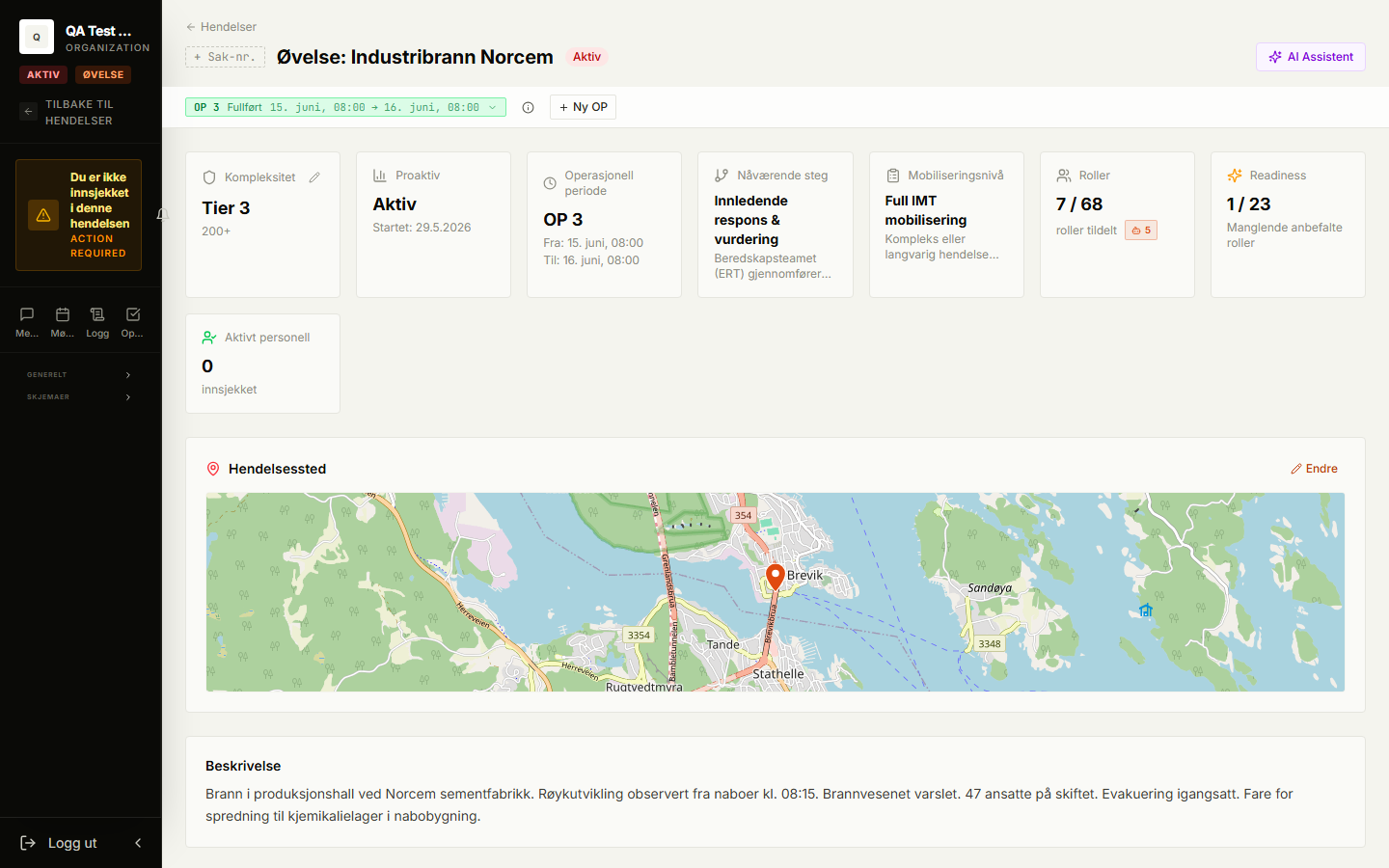
- SituationCommon operating picture with maps and map layers
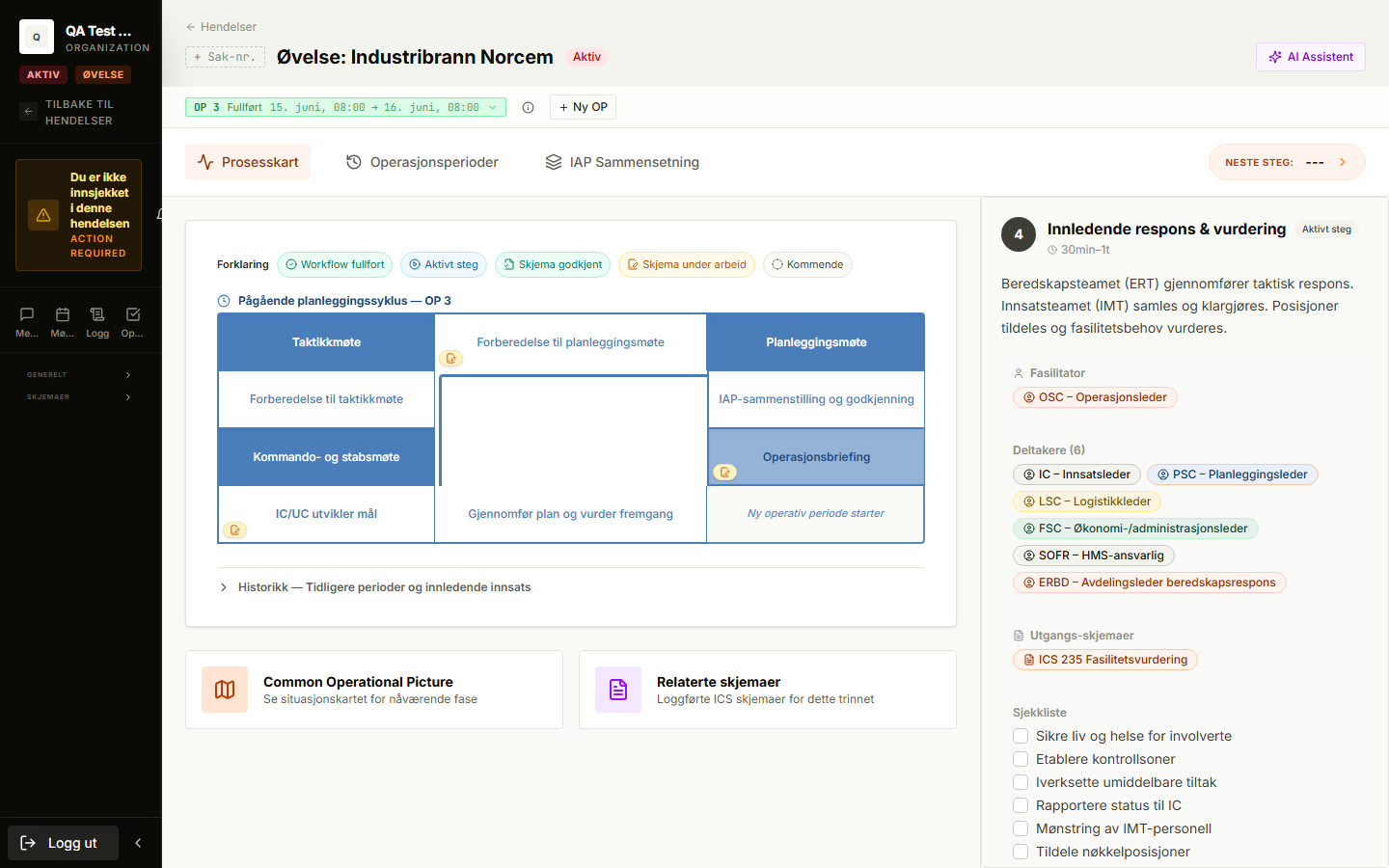
- MethodologyPlanning-P with the active step, not just a list of forms
- OrganisationRole-driven workflows and staff organisation
- FormsICS forms, including 213, 209, 215 and 234
- ResourcesResource tracking and finance
- DecisionsRisk and decision log
- LanguageNorwegian, English available
- ELSELS roles, order templates and action plan per the Norwegian civil protection guidance
- IUAIUA regions, zones, mobilisation and depot management
- InteroperabilityICS and ELS in the same operation, with orders and reports crossing between them
- DataStored in the EU
Enhetlig ledelsessystem, not just ICS
ELS is the Norwegian unified command system, developed by the Directorate for Civil Protection together with the Coastal Administration, and it is built on the Incident Command System. For Norwegian fire and rescue services and for the inter-municipal acute pollution committees, ELS is mandated by regulation. Rapid Response is built to answer both, and to let the two work the same operation.
The fire and rescue services regulation requires that during rescue operations the fire and rescue service is organised and led according to a national unified command system. The regulation on municipal preparedness against acute pollution requires inter-municipal preparedness to be built on a unified command system.
Those are two duties, not two recommendations. And they apply to two of the largest preparedness communities in Norway: the fire and rescue services, and the inter-municipal committees against acute pollution.
Most tools on the market are built for ICS or for nothing. Rapid Response carries the same methodology in two vocabularies: ICS terms for the continental shelf and international operators, ELS terms and Norwegian roles for fire services and pollution committees. The staff sees its own language, not a translation.
- RegulationFire and rescue services regulation, FOR-2021-09-15-2755
- RegulationRegulation on municipal preparedness against acute pollution, FOR-2022-01-04-10
- BasisThe ELS guidance from the Norwegian Directorate for Civil Protection, the Coastal Administration and the Environment Agency
- RolesAksjonsleder, leder operasjon, leder planlegging og miljø, sektorleder, teigleder. Norwegian ELS roles, not translated ICS titles
- ELS supportELS incidents, order templates, action plan
- IUA supportIUA regions and zones, mobilisation, depot management
- ICS supportPlanning-P, ICS forms, area command
On the relationship between ELS and ICS: ELS is not a competitor to ICS, it is the Norwegian adaptation of it. That is why a single tool can cover both. What a single tool cannot do is pretend the differences do not exist, and that is where most others stop.
One operation, two doctrines
An ICS-organised company and an ELS-organised pollution committee can work the same operation without either of them switching language. Each party keeps its own incident, in its own system, in its own terminology. The two incidents are linked, and orders, reports and resources cross that link as data, not as translations.
The reason this works is that there are not two data models. Position IDs and form IDs are the same under either doctrine — it is the labels that change. An ICS-209 and a situasjonsrapport are the same form. When the committee escalates its situation report to the action command, data moves. Nobody is reading a translation of anything.
Orders cross with direction and weight. An aksjonsordre (action order) passed down from the command is directive. An innspill (input) passed up from the committee is advisory. Both land as a real row in the recipient's own form, traceable back to the sender, and subsequent changes stay in step in both directions.
The link requires consent from both parties and is established with a one-time code, not by exchanging internal IDs. Shared resources keep their ownership tag, so neither party loses track of what is theirs.
- Data modelOne. Doctrine is presentation, not structure
- LinkTwo incidents, one per organisation, two-sided consent
- SetupOne-time code between the parties
- Order downAksjonsordre (action order), directive
- Input upInnspill (input), advisory
- ReportingEscalated as the same form, with provenance
- ResourcesShared with the ownership tag preserved
| In ICS | In ELS |
|---|---|
| Roles | |
| Incident Commander | Aksjonsleder (action leader) Innsatsleder when the response is subordinate to a higher level of command. The label follows the position in the hierarchy, not the other way round. |
| Safety Officer | Sikkerhetskoordinator (safety coordinator) |
| Operations Section Chief | Leder operasjon (operations chief) |
| Planning Section Chief | Leder planlegging og miljø (planning and environment chief) |
| Logistics Section Chief | Leder logistikk (logistics chief) |
| Finance / Admin Section Chief | Økonomi og administrasjon (finance and admin) In ELS this sits with the command staff rather than as its own section. The structure follows the doctrine, not just the wording. |
| Division Supervisor | Sektorleder (sector leader) |
| Task Force Leader | Teigleder (task force leader) |
| Strike Team Leader | Lagleder (team leader) |
| Forms and plan | |
| ICS-202 | Innsatsmål (response objectives) |
| ICS-205 | Sambandsplan (communications plan) |
| ICS-209 | Situasjonsrapport (situation report) |
| ICS-234 | MST, arbeidsanalysematrise (work analysis matrix) |
| ICS-204 | Aksjonsordre and sektorordre The Norwegian five-paragraph order sits on top of ICS-204, with fields read straight from ICS-201 and ICS-204. |
| Incident Action Plan | Innsatsplan (the ELS action plan) |
What it does not do: it does not merge two chains of command into one. Each organisation keeps its own command responsibility, and the command boundary is drawn explicitly in the org chart rather than hidden. Interoperability is not the same thing as unified command, and a tool that blurs the difference does nobody a favour when accountability has to be established afterwards.
Who it is built for
Fire and rescue services and inter-municipal pollution committees with a regulatory duty to meet, and organisations that have committed to ICS or are considering it. What they share: the staff has to master the method without everyone going through a training programme first.
We built the tool around how staffs actually behave when it is 02:30. Not around how a process map looks in a textbook.
Rapid Response is built by people who teach ICS themselves, who have evaluated the largest oil spill response exercises in Norway, and who have sat in municipal crisis management during real incidents. It is that same experience that makes the ELS side Norwegian practice rather than a translation of ICS.
- SectorsFire and rescue, IUA, oil and gas, power, public sector
- Method basisIncident Command System and enhetlig ledelsessystem (ELS)
- DevelopmentNorwegian
- Data storageEU
Want to see it in your organisation
We are happy to walk through Rapid Response against your own preparedness plan and exercise programme. Send an email, you get a reply from one of the three of us.